
A Bridge in Nazareth: How a Single Food Package Reached an Entire Family in Israel
6.16.2026
A Bridge in Nazareth: How a Single Food Package Reached an Entire Family in Israel
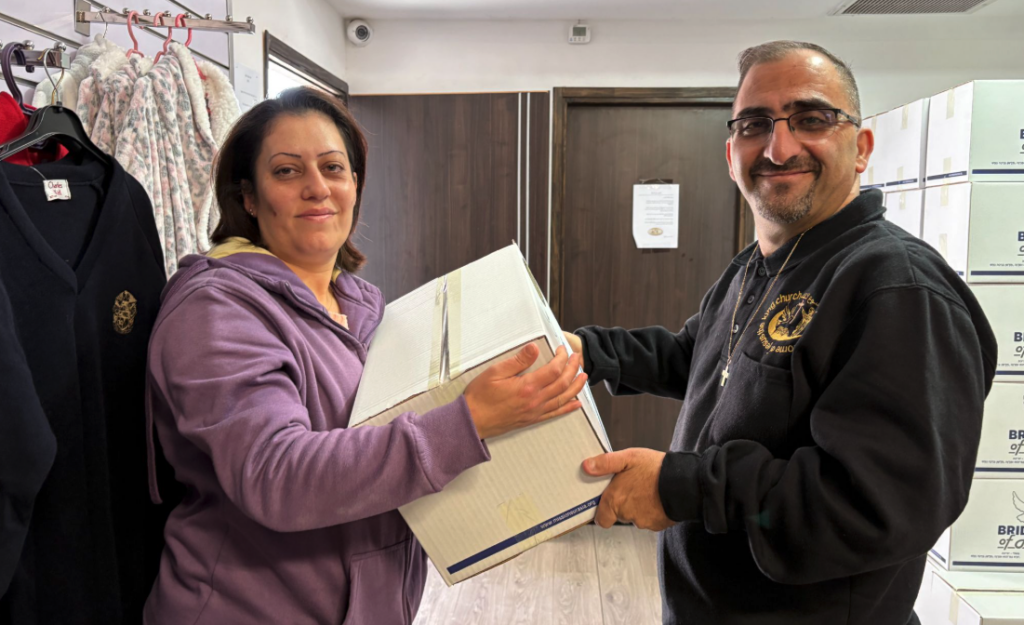
The lifeline arrived as a box of groceries. It is the kind of detail that can be easy to overlook—a casual gesture in a world often defined by its divisions. But for one family in Nazareth, that single food package became a bridge, proving that even amid profound hostility, the wall of division can be broken.
"For he himself is our peace, who has made the two groups one and has destroyed the barrier, the dividing wall of hostility." — Ephesians 2:14
The lifeline arrived as a box of groceries.
It is the kind of detail that can be easy to overlook — a transaction, a transfer of food from one set of hands to another, a momentary fix for a temporary shortage. But the woman who received it, Daria, knew what was inside the box before she opened it. She knew because she had been watching for it, and she knew because she had been praying for it, and she knew because she had reached the end of what she could do for her family on her own.
"I was overwhelmed with gratitude," she says, "and in that moment, I felt God's love surrounding me."
Daria lives in Nazareth, the Galilean town where Jesus grew up — a city that has, in the years since October 7, 2023, become an unlikely laboratory for one of the most difficult ministries imaginable: Arab and Jewish believers serving one another in a country at war.
The Church That Refuses to Stop Building Bridges
The food package came from Bridges of Hope, a humanitarian outreach established by Mission Eurasia that is located in an Arab evangelical congregation in Nazareth founded in 2009 by Pastor Saleem.
Pastor Saleem has led this congregation for more than 17 years; his wife Nisreen serves alongside him. The church has built, over those years, one of the most consistent ministries of reconciliation in the country. After the Hamas attacks of October 7, Pastor Saleem put it plainly: I will not stop building bridges. Even if it is destroyed, I will build again and again.
Daria's family is one of the bridges he helped to build through his partnership with Mission Eurasia.
What a Box of Food Actually Carries
The box of groceries was the visible part. The invisible part is what reached Daria's husband.
He had been struggling with his faith. Daria does not say where the struggle came from — perhaps the press of finances, perhaps the press of war, perhaps the long ordinary erosion that takes place in any household trying to hold itself together under pressure. What she does say is that when the help arrived, and when he saw the kindness that surrounded it, something in him began to thaw.
"Seeing how we were supported ignited a spark in him," she writes, "and our family began to come together in ways we never imagined."
A box of groceries does not, on its own, restore a marriage. But a box of groceries that arrives with no strings attached communicates something a sermon often cannot. It communicates that someone is paying attention. That the Christ whose name is on the building is, in fact, in the building.
A Movement of Bridges, Not a Moment
What happened to Daria's family is one fruit of a much larger movement. Since the October 7 attacks, Mission Eurasia and its partners in Israel have leaned into the Bridges of Hope effort at a scale that, in the present climate, is almost difficult to grasp.
[IMAGE PLACEMENT: Volunteers packing food boxes, or warehouse / distribution photo]
- More than 5,000 food packages were delivered to families and individuals in need.
- More than 58 Jewish and Arab Christian congregations working side by side in the same effort.
- More than 25,000 people touched through food, encouragement, and the message of hope in Christ.
In warehouses, in sanctuaries, and on quiet neighborhood streets, Jewish and Arab believers have crossed lines that history has, for generations, kept apart. Food has been prepared prayerfully. Aid has been delivered with dignity. And despite government-reinforced, anti-apostolatism restrictions that constrain how openly the gospel can be shared, the teams have continued to find innovative ways to put God's Word into the hands of families who would otherwise never receive it.
There is one more part of this story that matters deeply. Some of the first volunteers leading this effort were graduates of School Without Walls (SWW) in Israel — meaning that what looks, on the surface, like emergency relief is in fact the visible fruit of years of patient discipleship. SWW does not train responders for a crisis. It forms leaders for a lifetime. When the crisis came, those leaders were already in place.
What Daria Has Seen
Daria says it without theology. She says it the way a woman who has been on the receiving end of grace says it.
"The Bridges of Hope Ministry is not just about providing aid; it is about building bridges of reconciliation between Arabs and Jews. Through this work, we are learning to love one another and see each other as family."
That sentence costs more than it appears to cost. In Israel, in the year of our Lord 2026, it costs a great deal.
How to Stand With Bridges of Hope
Pray
Pray for Daria's family — for her husband as faith returns, for the daughters who are growing up watching reconciliation happen in real time, and for Pastor Saleem and Nisreen as they continue to build bridges in a country that, every day, gives them reason to stop. Pray for the Arab and Jewish believers who are choosing to be family across lines most of the world considers unbridgeable. Join the prayer movement →
Give
A gift to Bridges of Hope funds the food packages, the humanitarian outreach, and the quiet, costly work of reconciliation across Israel. Every box that goes out is a sermon preached without a single word — a sermon that, as Daria's family has discovered, can change everything. Support Bridges of Hope →
A box of groceries reached a family. The family is reaching a city. And the city is, slowly, in the small space of one church, becoming what Nazareth was always meant to be.
Send a Sermon Without a Single Word
In Nazareth, a simple box of groceries became a bridge of hope that restored a family’s faith and proved that Christ is alive. Amid profound hostility, Arab and Jewish believers are standing together to serve families under pressure. Your gift provides critical food packages, tangible relief, and the long-term hope of the gospel.